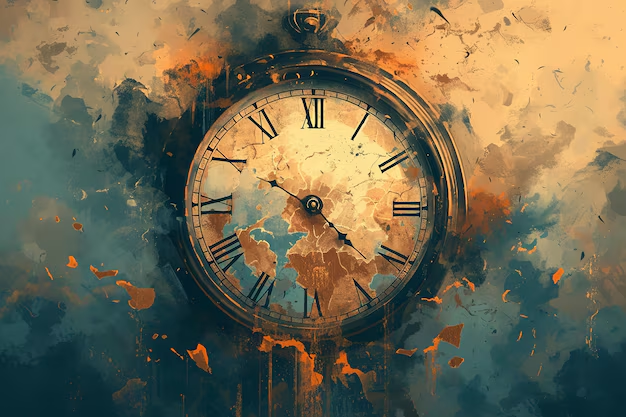
A Journal Narrative
In the quiet archives of memory, where dust settles on forgotten ledges and the weight of centuries presses against the present, I find myself wandering through the ruins of what we call progress. Not as a straight road carved by steady hands, but as a vast, intricate structure—the Architecture of Time—built in layers of stone, code, and silence. Some chambers soar with precision beyond our grasp; others lie collapsed, their blueprints erased by flood, fire, and forgetting.
We like to imagine human civilization as a linear ascent: from crude stone tools in the Paleolithic haze to the glow of quantum processors humming in server farms. A comforting story of unbroken climb. Yet when you step back and trace the blueprints, the lines fracture. What emerges is not a gentle slope, but punctuated equilibria—long ages of near-stasis shattered by sudden leaps, followed by mysterious regressions. The true architecture reveals itself not in the visible spires, but in the hidden foundations and the voids where entire wings once stood.
The Long Stasis
For over 200,000 years, our ancestors moved through the world in a profound equilibrium. Tools changed so slowly that a lifetime could pass without witnessing meaningful innovation. The same hand-axes, the same fire-making techniques, passed down like sacred but unchanging rituals. Technological progress was not a river flowing steadily toward the sea; it was a still lake, its surface barely rippled.
Then came the Holocene Breakout—a mere blink in geological time. Agriculture took root, cities rose, and within a geological instant, we harnessed steam, electricity, and silicon. Why did it take so long? Why only in this fragile 0.1% window of our species' existence did the curve bend sharply upward? The standard model offers answers rooted in gradual accumulation. But the stones and artifacts whisper of something else: perhaps repeated resets, lost libraries, and civilizations that reached heights only to watch their towers crumble back into the earth.
Anomalies in the Stone and Bronze
Walk the corridors of deep antiquity, and you encounter doors that refuse to fit the linear blueprint.
In 150 BC, off the coast of Greece, divers recovered the Antikythera Mechanism—a bronze device of astonishing complexity. Differential gears, astronomical calendars, predictive models of celestial motion. Nothing like it would reappear in Western clockwork for another 1,500 years. A peak, followed by a long, inexplicable descent.
Far earlier, around 2500 BC, the builders of the Great Pyramid at Giza aligned its sides to True North with an error of just 3/60ths of a degree. They quarried, transported, and placed over 2.3 million massive stones with optical precision that would challenge modern skyscraper engineers. This was not the work of a nascent civilization fumbling toward competence. It felt like the inheritance of refined knowledge—mastery already achieved.
Even further back, at Göbekli Tepe in 9500 BC, hunter-gatherers erected massive T-shaped megaliths in elaborate enclosures, long before the supposed dawn of agriculture or metallurgy. Complex organization without the settled surplus we assumed was required.
These are not isolated curiosities. They form part of the Regression Paradox: the earliest monumental works of certain civilizations often display engineering and craftsmanship superior to much of what followed for centuries or millennia. Knowledge, it seems, is frequently inherited, then slowly degraded, rather than patiently built from scratch.
The Library and the Information Bottleneck
At the heart of this architecture lies not raw intelligence, but transmission fidelity—the fragile pipes through which knowledge flows across generations.
Centralized repositories have always been points of catastrophic failure. The Library of Alexandria once held the accumulated wisdom of the ancient world. Its loss did not merely delay progress; it severed arteries of mathematics, astronomy, and engineering, plunging entire fields into darkness for centuries.
Economic surplus forms another choke point. When climate shifts, wars, or collapses drain the energy needed to train specialists and maintain complex systems, techniques vanish. The specialists die, the apprentices scatter, and the scaffolding of civilization rots.
Then came a quiet revolution in 1440 AD. Johannes Gutenberg’s printing press did something profound: it turned knowledge from a single vulnerable flame into thousands of redundant copies. It created the first true decentralized backup of human thought. Ideas became harder to erase. Progress gained a measure of resilience against entropy.
The Digital Dark Age
Today we stand in a new chamber, glittering with data yet strangely brittle.
Our hard drives last perhaps a decade. Magnetic tapes and optical discs degrade. Software formats from barely twenty years ago often refuse to open, creating silent gaps in the record. We generate more information than any civilization before us, yet store it on media far more ephemeral than Sumerian clay tablets baked in the sun.
We risk becoming architects of a Digital Dark Age—not through lack of knowledge, but through the impermanence of its vessels. The very acceleration that defines our era may outrun our ability to preserve its foundations.
Toward Resilience
The Architecture of Time teaches a sobering truth: technological progress is not a guaranteed constant, but a fragile emergent property of specific information-sharing systems. Time alone builds nothing. Systems of transmission and redundancy do.
Civilizations before us left anomalies—whispers of lost complexities in Egypt, Sumer, and the Aegean. Their regressions warn us. In an age of unprecedented data richness, our challenge is the Medium Problem: ensuring our knowledge outlasts the fragile silicon and magnetic fields we entrust it to.
We must design not only for acceleration, but for endurance. Global Knowledge Vaults modeled on seed banks. Durable analog redundancies. Decentralized architectures that laugh at catastrophe.
Because entropy is patient. It waits in the cracks of every empire, every library, every server farm.
And the architecture we build today will one day be someone else’s ruins—or their foundation.
© 2026 Strategic Research Review | Document 882-Alpha
What hidden chambers of time will we choose to reinforce? The blueprint is ours to redraw.
Responses & Discussion
Join the discussion! Login to share your thoughts.
No responses yet
Be the first to share your thoughts about this article.